
3D Scanning
Accurate proportions are the most important foundation for weapon art. 3D scanning is one of the most time-efficient ways to get them. Over time, working with scan data also develops the artist’s eye for form and proportion.
The more data the team has at the start, the better the final result can be.
However, no single reference type solves every problem. The required quality level defines how much time should be invested in collecting, creating, and validating references. For high-end weapon art, especially in VR, accurate proportions are one of the most important foundations.
A scan helps solve a fundamental requirement for the artist: proportion. Once the artist understands the real scale, mass, and silhouette of the object both mentally and in 3D space - the reproduction of smaller details becomes much faster and more controlled.
In the long term, 3D scanning or metrically correct blockout is a good tool for developing the artist’s eye. Working with accurate data from the real world helps artists better understand proportions, placement of details, functional logic and overall aesthetic of an object.
Photogrammetry
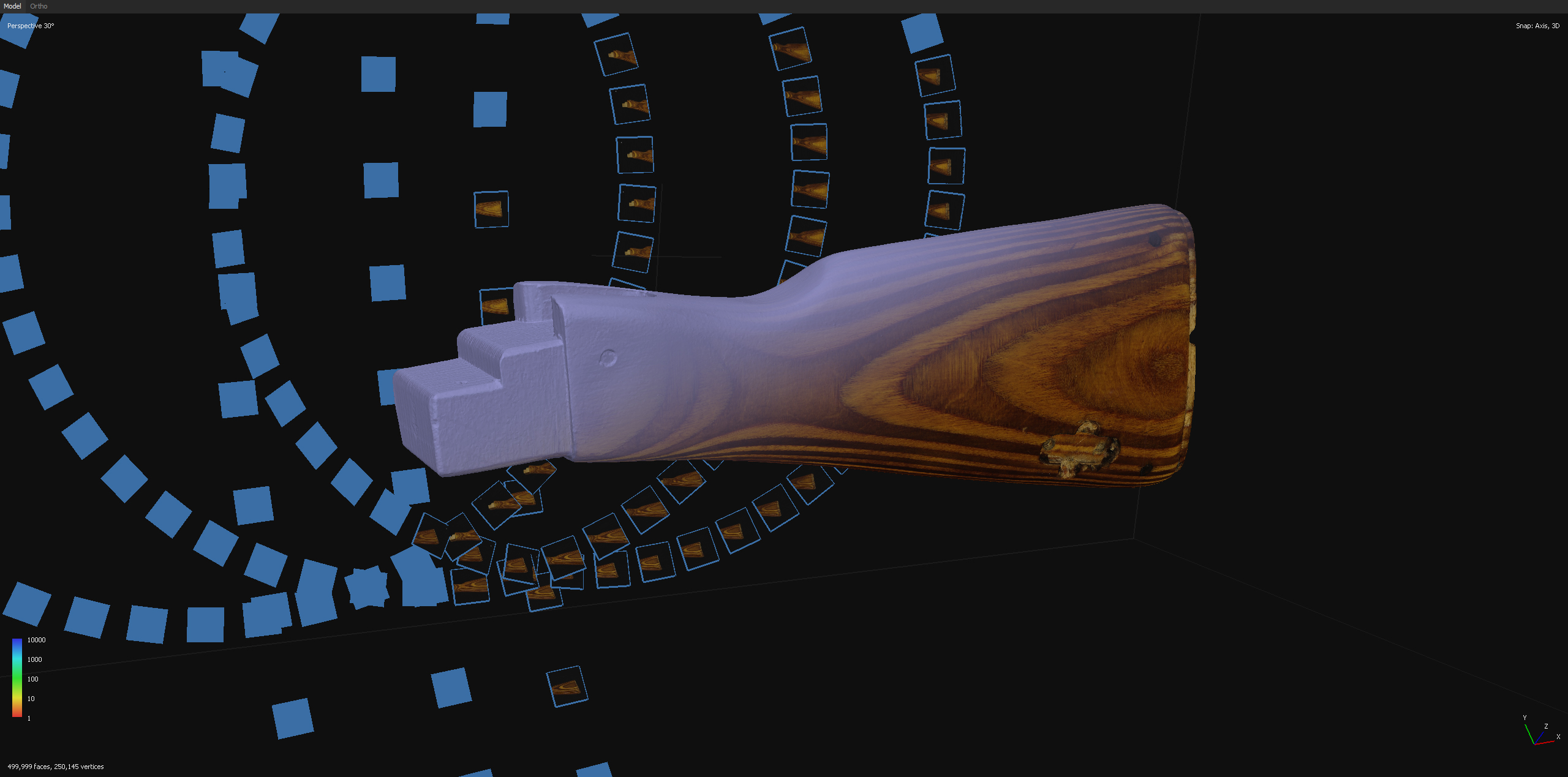
Screenshot example from Agisoft Metashape
Most accessible entry point. Reconstructs geometry from photos - also captures color/texture data. Works well with diffuse surfaces. Limited by reflections, black/glossy materials, and processing time.
Photogrammetry is one of the most accessible entry points into 3D scanning. It reconstructs geometry from a large number of photographs taken from different angles. In addition to geometry, it can also produce diffuse or color texture data.
Advantages: Accessibility - in its simplest form, it requires only a camera. Works well with diffuse surfaces and can capture valuable color information for material creation.
Hardware: From a basic camera setup to an advanced production rig:
- Neutral background and programmable turntable
- Cross-polarization setup
- Full-frame 50+ megapixel mirrorless camera with 50mm lens
- Scale bars or QR markers
- Evaporating dulling spray for reflective surfaces
Limitations: Time-consuming alignment and cleanup. Not pure geometric ground truth - affected by depth of field, motion blur, reflections, and compression. Black, glossy, transparent, or highly reflective objects are especially problematic.
LiDAR
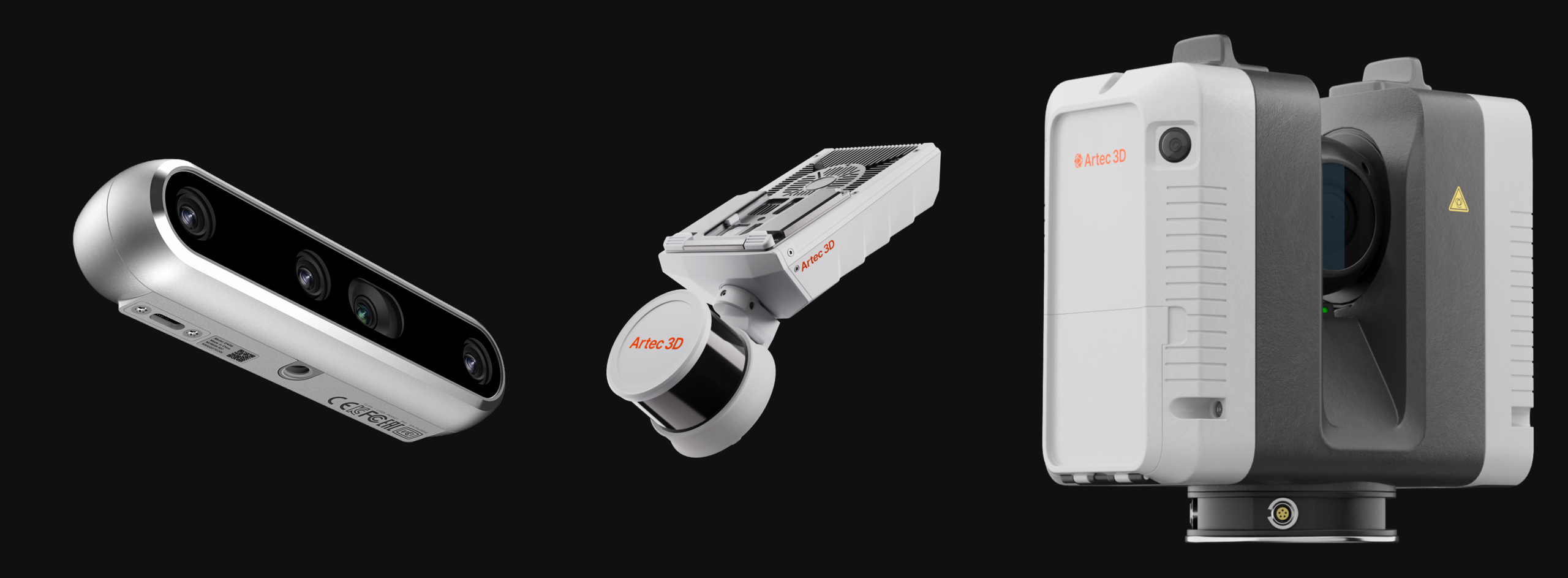
Intel RealSense, Artec Jet, Artec Ray
Optimized for environments and architecture, not weapon-scale detail. Usually insufficient resolution for bevels, screws, and surface wear that matter in weapon art.
LiDAR is generally not the best solution for medium or small weapon assets. Most LiDAR implementations are optimized for environment capture, architecture, large-scale spatial scanning, and long-distance measurement.
For weapon art, where small bevels, screws, grooves, stamped details, edge transitions, and surface wear matter, LiDAR usually does not provide enough detail compared to structured light or high-quality photogrammetry.
Structured Light (Sinusoidal / Phase Shift)
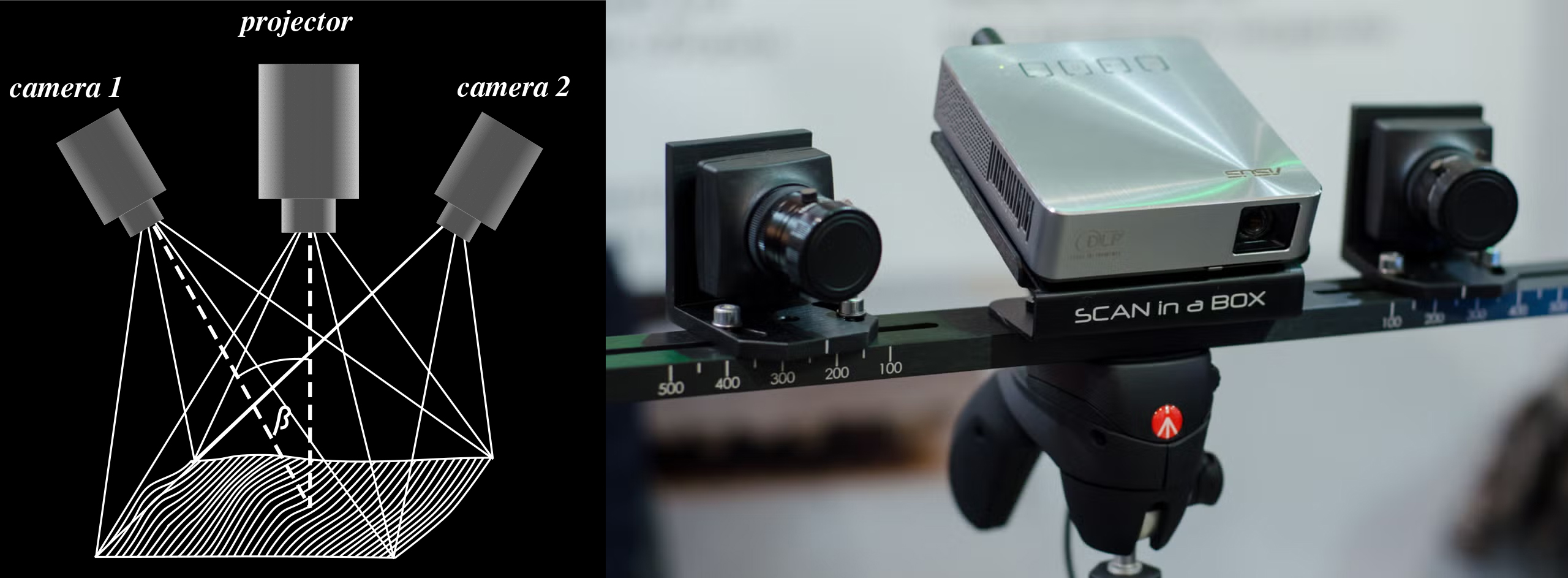
Scan in a Box example
One of the strongest solutions for accurate geometry - up to micron-level precision. Projects known patterns onto the surface and calculates shape from deformation. An AR-15 grip can generate hundreds of millions of polygons.
Structured light scanning, especially sinusoidal or phase-shift-based systems, is one of the strongest solutions for capturing accurate geometry. In premium setups, it can achieve extremely high precision, sometimes down to micron-level accuracy.
Advantages: Highly reliable geometric information. Unlike photogrammetry, structured light actively projects known patterns onto the surface and calculates shape based on deformation - much closer to ground-truth geometry. Open systems can be adapted for different object sizes and scanning distances.
Hardware:
- 720p or 4K projector
- One or two grayscale machine vision cameras
- Calibrated camera-projector setup with stable mounting
- Turntable and controlled lighting
Best practices: Cross-polarization, programmable turntable, 4K projector, two 10+ megapixel greyscale machine vision cameras, regular calibration.
Limitations: More stationary and slower than handheld scanners. Calibration must be performed frequently. Texture capture quality is usually limited with grayscale cameras.
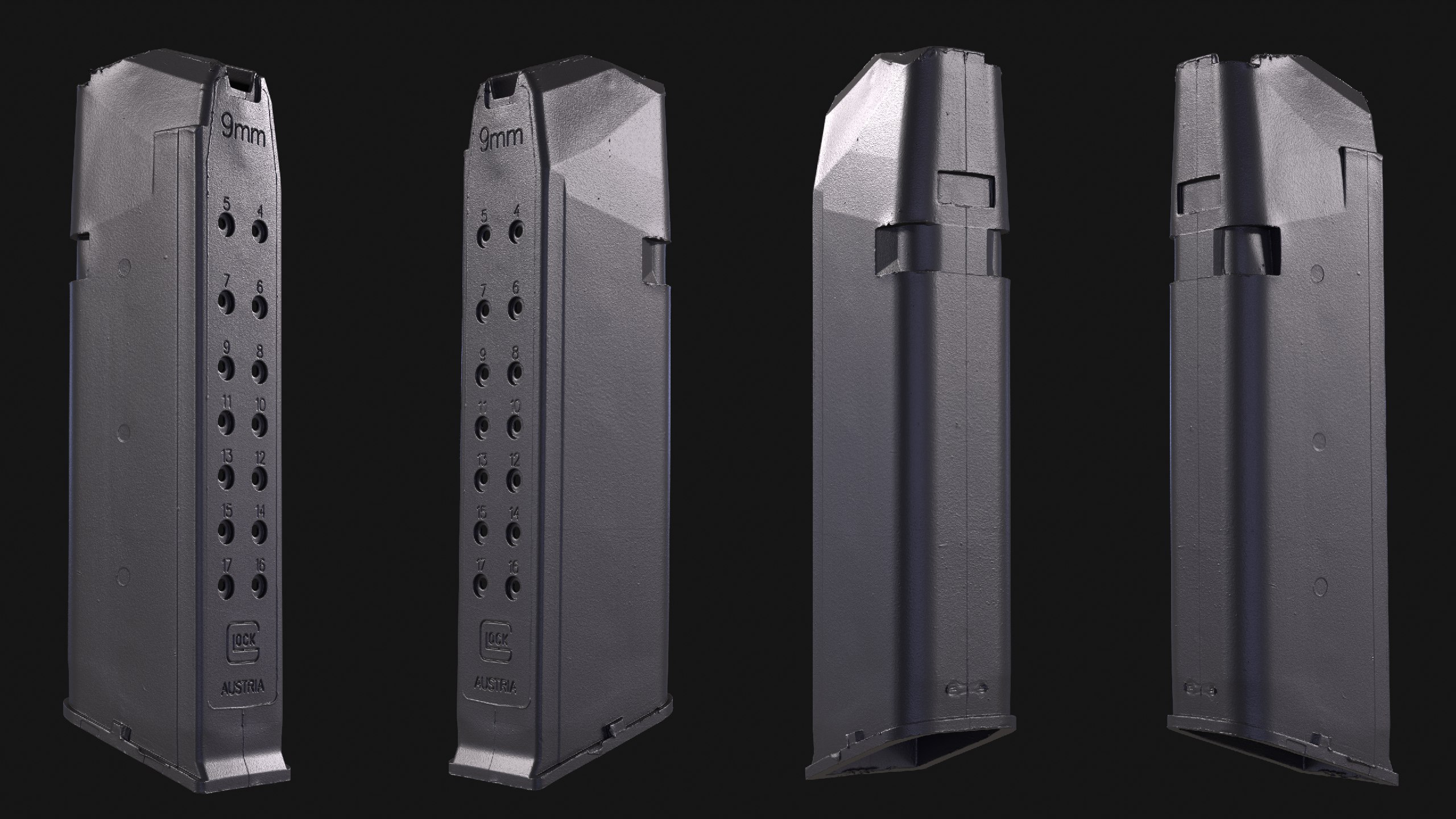
Quality of Phase Shift Scan example
Handheld Structured Light
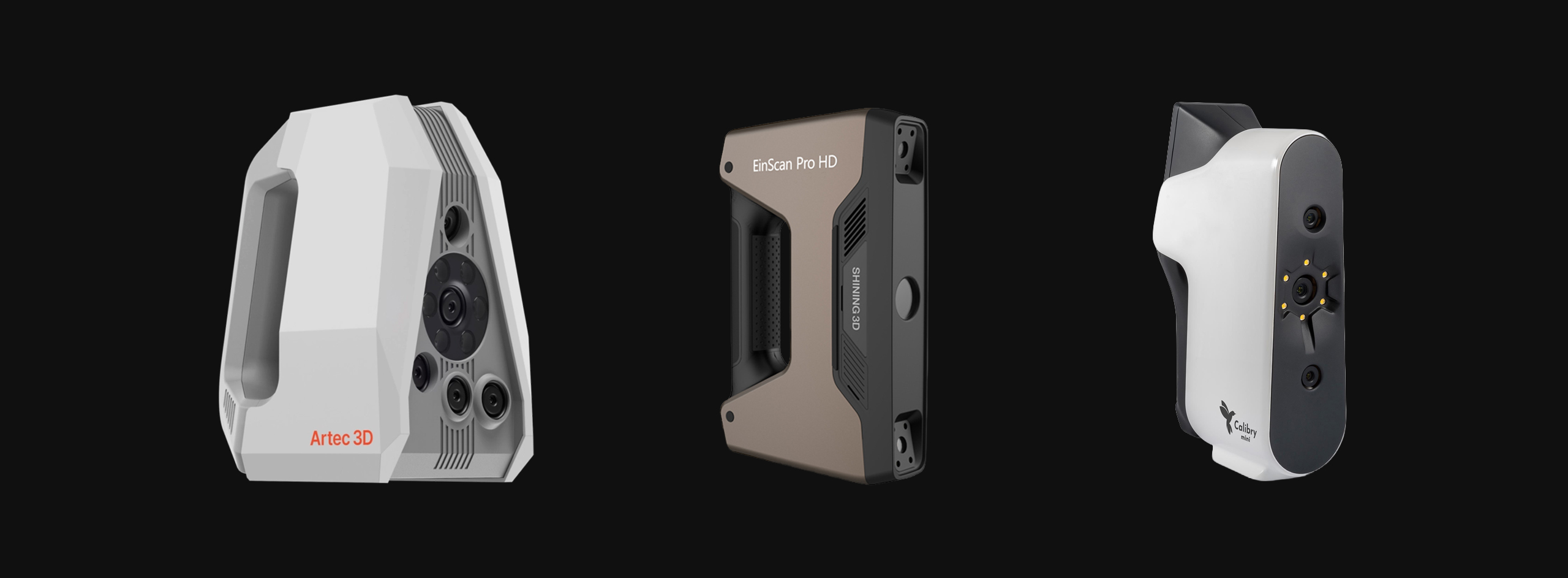
Artec Spider, EinScan Pro, Thor3D Calibry Mini
Fast, interactive scanning - great for characters, assembled weapons, and offsite work. Sits between stationary structured light and laser scanning. Cost and calibration are the main limitations.
Handheld structured light scanners allow the operator to move around the object and capture it interactively. They can automatically align scan data during capture, significantly speeding up the process.
Useful for: Characters, small props, assembled weapons, partially disassembled weapons, quick offsite scanning, fast proportion capture.
Limitations: High-precision models are expensive. Capture volume may be limited. If hardware drifts after years of use, calibration may require sending the device to the manufacturer. Software licensing can be a significant cost.
Laser Scanning
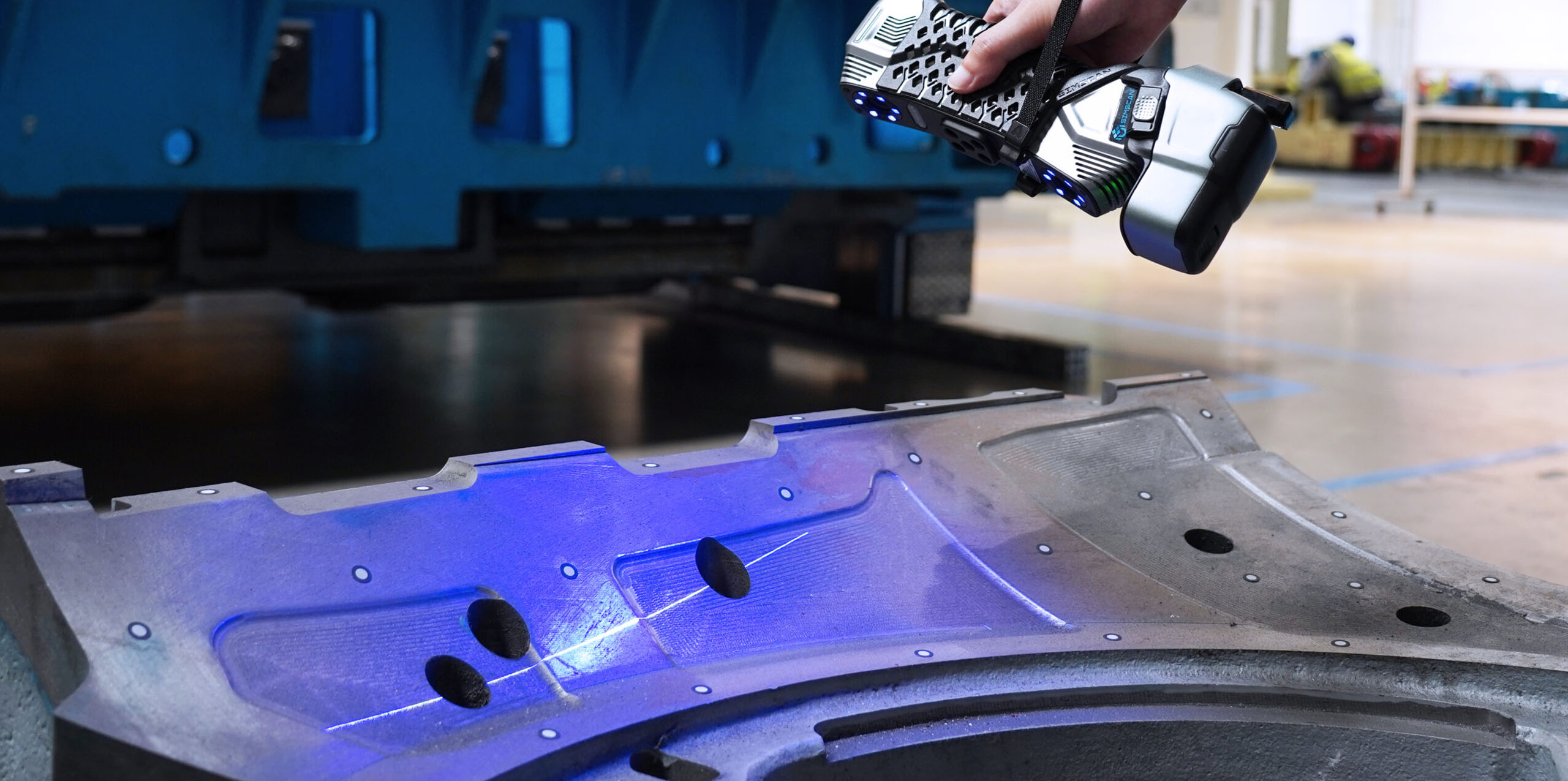
SCANOLOGY SIMSCAN
Effective for difficult surfaces - more stable on black or glossy materials where optical methods struggle. Requires visible markers for tracking. Usually no texture capture.
Some laser scanning solutions are niche but highly effective. A handheld laser scanner can work both in static setups and in motion, gradually filling the scanned scene. Laser scanning can be more stable on black or glossy surfaces compared to some optical methods.
Setup: Marker-covered turntable, tripod, scanner mount, 45-degree scanning angle, controlled lighting, careful object positioning.
Limitations: Many laser scanners rely on visible markers for tracking and alignment. Some do not capture texture data - useful primarily for geometry, must be combined with separate photographic reference.
Additional Capture Technologies
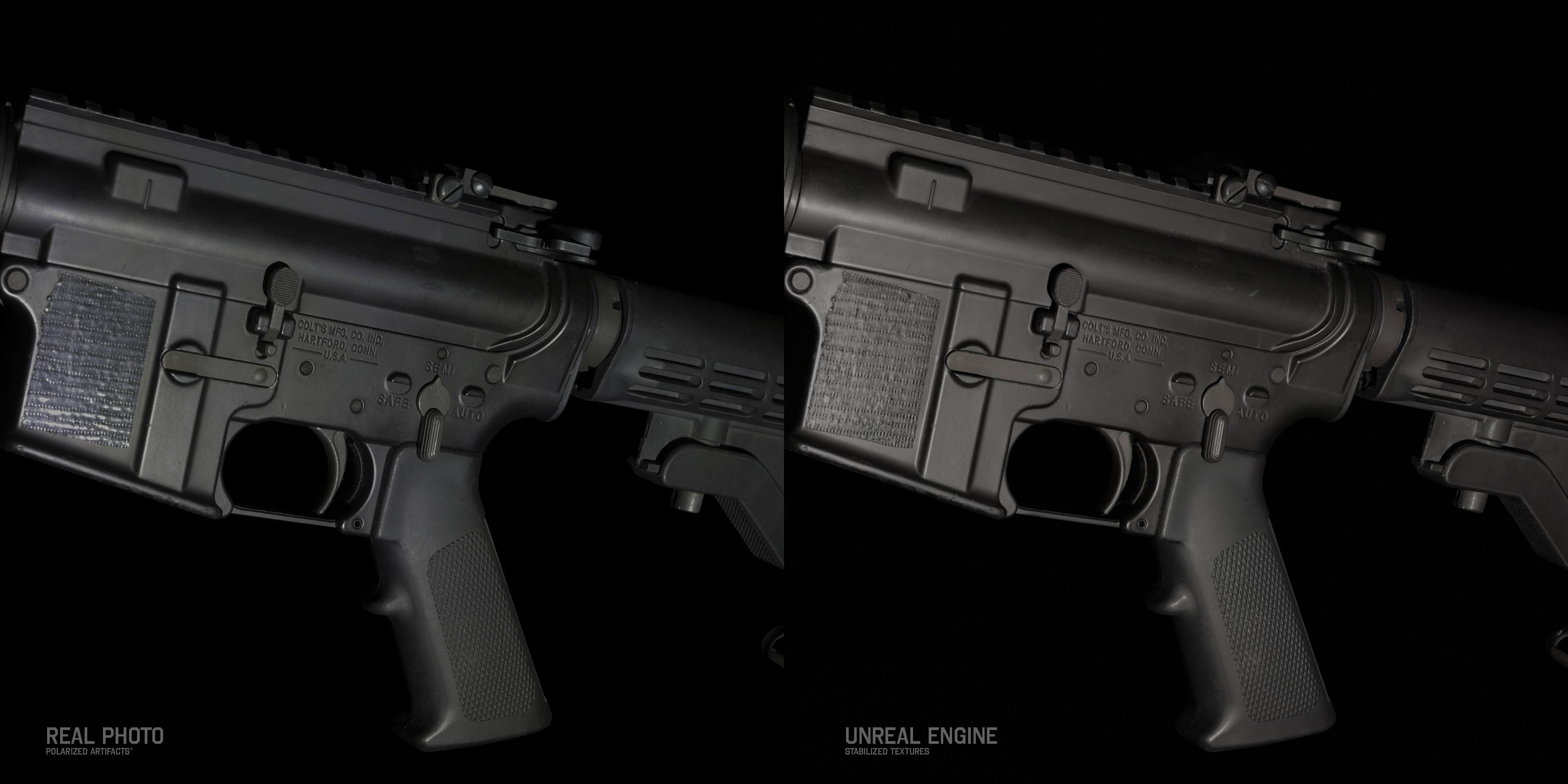
Photometric stereo captures surface normals and PBR data under controlled lighting - widely used in film for digital doubles. Multispectral analysis studies material response across wavelengths. Gaussian splatting is useful for view-dependent appearance but not production-ready geometry.
Photometric Stereo
The camera captures the same surface under different known lighting directions. Because the system knows where the light sources are, it can estimate surface normals, microstructure, and material response. Widely used in film production for facial scanning and high-end digital doubles. Extremely valuable for capturing PBR material information and building material libraries.
Multispectral Analysis
Uses bandpass filters and different wavelengths of light to study how materials respond across the spectrum. Can help reconstruct more accurate material behavior for PBR workflows. Not yet widely used in standard game production, but our early R&D was promising.
Gaussian Splatting
Uses image-based data similar to photogrammetry but reconstructs a visual representation through a different method. Useful for understanding view-dependent surface appearance, but should not be treated as a direct replacement for production-ready geometry.
Practical Workflow at Keal Studio
We combine multiple scanning systems: stationary structured light for precision parts, handheld structured light for speed, and photogrammetry + photometric capture for PBR texture data. No single method is universal - the best results come from combining technologies.
In the current production workflow, Keal Studio uses several scanning technologies depending on the asset type, required accuracy, and production constraints.
Structured Light (Stationary): Our main workhorse before acquiring a handheld scanner. Performs extremely well for both small details and overall proportions. Especially useful when a weapon can be disassembled - each component scanned separately with high precision. Open system can be recalibrated, making it strong for both studio and offsite scanning.
Handheld Structured Light: Now used for characters, small props, and weapons - both fully assembled and partially disassembled. Main advantage is speed. Can also be connected with automation systems such as ROS.
Photogrammetry + Photometric Capture: Used to collect PBR texture data. Especially valuable for character work and material library creation. When combined with structured light geometry, the result can be a highly detailed PBR asset ready for retopology and baking - sometimes significantly reducing the traditional manual texturing stage.
Why Multiple Scanners Matter: Using multiple scanning systems gives flexibility. If one method is not ideal for a specific surface, scale, or material, another can fill the gap. The goal is a reference pipeline where each method contributes what it does best: accurate geometry, material behavior, texture data, or production speed.